
Green hydrogen into an existing ammonia plant: whose emissions are whose?
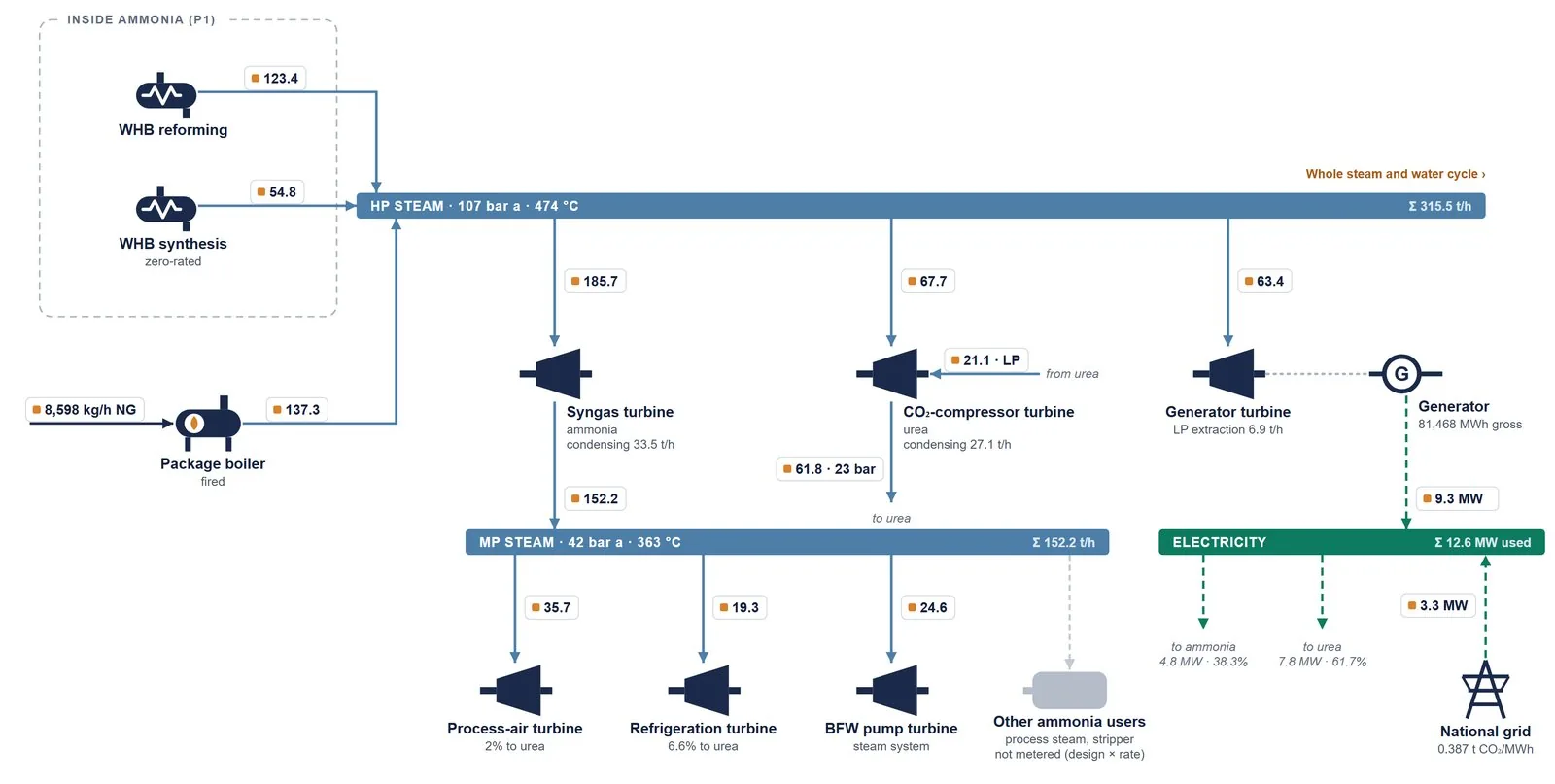
An old plant, a new green hydrogen stream, one shared steam system. The question was how much of the ammonia can honestly count as renewable. Client and project names are withheld.
One plant, two kinds of hydrogen
A renewable fuel of non-biological origin (RFNBO) must show at least 70% GHG savings against a 94 g CO₂e/MJ fossil comparator. A new plant can be designed to pass. An existing plant that adds a green hydrogen stream cannot be designed again: it still has its steam system, its power supply and its conventional hydrogen, and the green and the grey molecules end up in the same product.
So the owner needed an answer to three questions a verifier would ask. Which share of the ammonia is renewable? What is the carbon intensity of each product? And can every step be traced to a measurement or a published rule?
Result
Cradle-to-grave GHG model · audited precertification
85.7%GHG savings against the 94 g CO₂e/MJ comparator, above the 70% threshold. Names withheld for confidentiality.
Three things that make a brownfield site different
Shared steam and power
The plant's utilities serve the renewable and the conventional route at the same time. Splitting them by a rule of thumb gives a number nobody can defend.
Co-processing
Green and conventional hydrogen become one product stream. The renewable share has to be derived from the balances, not declared.
Renewable power evidence
The electricity behind the green hydrogen must meet the additionality and correlation rules, and the evidence has to match the hours the plant ran.
From the plant's balances to a number a verifier can follow
- Drew the boundary. Which gas, steam, power and product streams belong to the renewable route, and which to the existing plant.
- Closed the balances, then allocated. Mass, energy and carbon first; shared steam and power were then split on those balances, with the method written down and open to challenge.
- Built the GHG model. Cradle to grave, with the regulatory factors built in, so a rule change is a change of one input.
- Supported the audit. Evidence for the renewable power, and the model's trail handed over for the audited precertification.
If your plant is simpler, the work is simpler
Shared utilities, own power and co-products are the ordinary case in CBAM, in RFNBO and in inventories. The same boundary, balance and allocation steps apply. What changes is the scheme's rulebook, not the engineering.
- CBAM: embedded emissions per CN code, see the method
- RFNBO and e-fuels: see the service
- Scope 1-2-3 and product footprints: see the service
Start small: one phase, one fixed price.
A 3–5 day CBAM Phase 0, a one-day allocation workshop, an LTSA contract review, a one-building US pilot or one Academy course.